A king, a shipyard and a Sunday afternoon
Vasa was meant to be the most powerful warship in the Baltic. She was built in two years and lost in twenty minutes.
Vasa, the Swedish warship of 1628. Dates and figures come from the sources linked beside them; where sources disagree, we show each one.
The king who ordered her
Gustav II Adolf (1594–1632) was the grandson of Gustav Vasa, the first king of the Vasa dynasty. Vasa Museum
He inherited three wars when he became king in 1611, with Russia, Denmark and Poland-Lithuania, and was at war for 18 of the 21 years of his reign. Vasa Museum
The king, a keen artillerist, wanted big, heavily gunned ships for artillery duels; most similar orders were cancelled after he died, because the navy did not want such ships. Vasa Museum
The name comes from ‘vase’, an old word for a sheaf of grain or a bundle of twigs, which was the Swedish royal family’s symbol. Vasa Museum FAQ
The stern carries a gilded sheaf between two cherubs as the ship’s name board, and the king’s initials GARS, for Gustavus Adolphus Rex Sveciae. Vasa Museum
The contract
In January 1625 the king signed a contract with the Dutch master shipwright Henrik Hybertsson and his business partner Arendt de Groote to build four new ships. Vasa was to be the most powerful warship in the Baltic. Vasa Museum timeline
A 1969 US Naval Institute article says the king ordered Vasa ‘and two other ships’ in January 1625. USNI Proceedings, 1969
Like the rest of the royal navy, Vasa belonged to the king: Gustav II Adolf, who ordered the ship in 1625. Vasa Museum FAQ
The shipyard
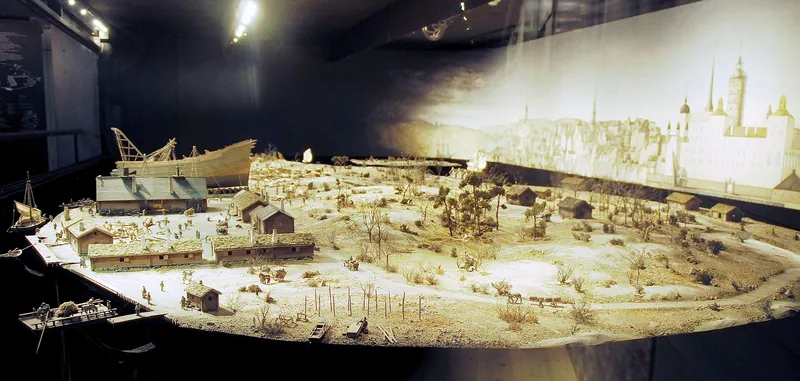
The navy yard was on Skeppsholmen, today the peninsula called Blasieholmen, then an island reached by a guarded wooden bridge. Vasa Museum
In the warm months over 400 people worked at the yard. About half were year-round staff recruited in Sweden; the rest were seasonal workers, mostly from the Netherlands and Germany, paid about twice as much. Vasa Museum
The two groups spoke different languages, trained in different traditions and used different systems of measurement. Vasa Museum
Timber came from estates south and west of Stockholm, sawn planks from Riga and Amsterdam, tar from southern Sweden and Finland, hemp from Latvia, coal from England and sailcloth from the Netherlands and France. Vasa Museum
Building Vasa
Vasa’s keel was laid in late winter 1626 at Skeppsgården, the navy yard in Stockholm. Vasa Museum timeline
Hybertsson was already ill when work started. By the summer of 1626 he could no longer supervise, and his assistant Hein Jakobsson took over the ship; Hybertsson died barely a year later. Vasa Museum timeline
The museum’s exhibition says Margareta Nilsdotter, Hybertsson’s widow, led the building of Vasa after he died in the spring of 1627. Vasa Museum
Vasa was launched in the spring of 1627, and hundreds of craftsmen spent the summer finishing the hull and rigging. Vasa Museum timeline
When was the keel laid, and who finished the ship? Sources differ
- Vasa’s keel was laid in late winter 1626 at Skeppsgården, the navy yard in Stockholm. Vasa Museum timeline
- Vrak, the Museum of Wrecks, gives the keel-laying as 1625. Vrak museum
- Hybertsson was already ill when work started. By the summer of 1626 he could no longer supervise, and his assistant Hein Jakobsson took over the ship; Hybertsson died barely a year later. Vasa Museum timeline
- The museum’s exhibition says Margareta Nilsdotter, Hybertsson’s widow, led the building of Vasa after he died in the spring of 1627. Vasa Museum
The Vasa Museum’s timeline says 1626; Vrak says 1625, the year of the contract. On who took over, the two museum accounts may describe different jobs: Hein Jakobsson supervising the shipwrights, and Margareta Nilsdotter leading the business her husband had run. We have not found a source that says so directly.
How long was Vasa? Sources differ
- Finished, Vasa was 69 metres long and more than 50 metres tall from the keel to the top of the mainmast. Vasa Museum timeline
- Vrak’s fact box gives Vasa’s length as 47 metres and her width as 11.5 metres. Vrak museum
Neither page says exactly what it measures, so we give both.
The guns
She carried 64 cannon on her maiden voyage, but eight gunports were empty: the yard could build a ship faster than the royal foundry could cast guns. Vasa Museum
The main armament was 48 bronze 24-pounders, each firing a ten-kilogram ball, with eight 3-pounders and six short guns for close-range work on the upper deck. Vasa Museum
Vrak says the 48 big guns weighed about 1,200 kilograms each. Vrak museum
One side’s guns could fire 250 kilograms of shot at once: about four times a typical Swedish warship of the 1620s, and twice the largest ships of other northern European navies. Vasa Museum
The sculptures
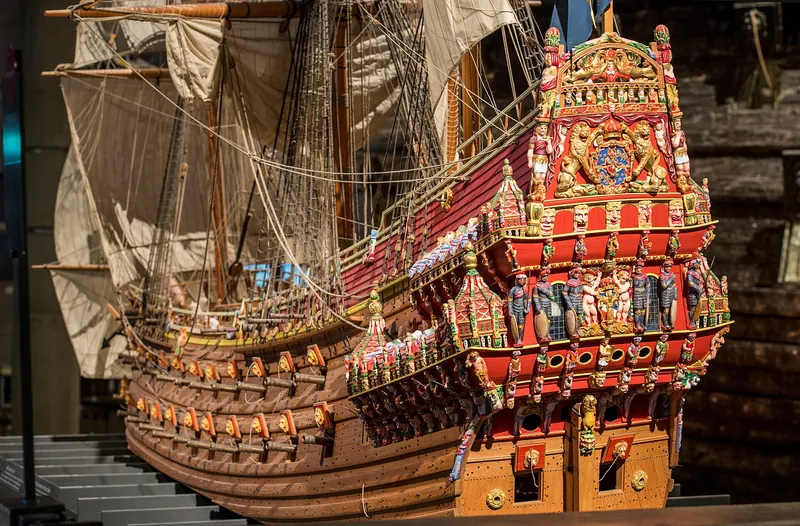
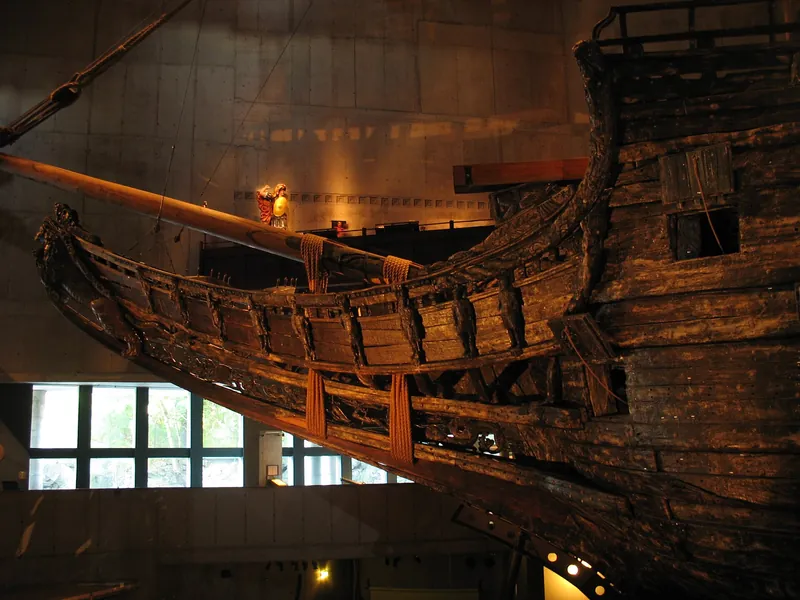
There were over 700 sculptures and decorations on the ship, meant to show that Gustav II Adolf was the rightful king with God on his side. Vasa Museum
The figurehead is a three-metre lion holding the Vasa coat of arms, with twenty Roman emperors along the beakhead behind it. Vasa Museum
From the toilets in the beakhead, the crew looked at two carved Polish noblemen: Sweden’s enemy, shown humbled. Vasa Museum
Mårten Redtmer, a German master sculptor, carved several of the most important figures, with the Dutchman Johan Thesson and the German Hans Clausink. Vasa Museum
From 1990 to 2002 Peter Tångeberg analysed about 1,200 paint samples. Vasa was bright: strong colours and gold leaf on the sculptures, much of the ship painted red, the rest tarred red-brown. Vasa Museum
Crew and soldiers
The navy’s plan for 1628 was 133 sailors and 300 soldiers; the soldiers would only board for battle service and were not aboard when she sank. Vasa Museum
With soldiers aboard, about 450 men would have shared less than 600 square metres of living space. Vasa Museum
The test
Before she sailed, captain Söfring Hansson had 30 men run back and forth across the deck while Vice Admiral Klas Fleming watched. The ship rolled so much that the test was stopped for fear she would capsize at the quay. Vasa Museum
Fleming was overheard to say ‘If only His Majesty were at home!’, but he did not report it, and the king was pressing for the ship to go to sea. Vasa Museum
10 August 1628
10 August 1628 was a Sunday. Crew families were allowed aboard for the first leg; guests, including women and children, were to get off at the Vaxholm fortress. Vasa Museum
She was bound for the fleet base at Älvsnabben in the Stockholm archipelago, to be flagship of the reserve squadron. Two companies of soldiers, 300 men, were to board there. Vasa Museum
She cast off from below the palace between four and five in the afternoon. With the wind from the south she was warped along the waterfront to what is now Slussen, then four of her ten sails were set and a salute was fired. Vasa Museum
Under the cliffs of Södermalm there was little wind. A small gust made her heel and slowly recover; at the gap in the cliffs at Tegelviken a stronger gust pushed her so far over that water poured in through the open lower gunports. Vasa Museum
Within minutes she was on the bottom, 32 metres down, with her masts sticking out of the water. Some people held on to the masts, some were picked up by small boats, and some swam the 120 metres to Beckholmen. Vasa Museum
Vasa sailed for only about 20 minutes before water started coming in through the lower gunports. Vasa Museum FAQ
Thousands of Stockholm’s people watched, along with several foreign ambassadors. Vasa Museum timeline
All but 30 of the crew and guests survived, the Vasa Museum says. Most of the dead were trapped inside the ship. Vasa Museum
Among the dead was Captain Hans Jonsson, the ship’s first-named captain, still aboard because a second experienced captain often sailed on a new ship’s first trip. Vasa Museum
Of the roughly thirty who died, only one is named in the historical sources: Captain Hans Jonsson. Vasa Museum
How many were aboard, and how many died? Sources differ
- All but 30 of the crew and guests survived, the Vasa Museum says. Most of the dead were trapped inside the ship. Vasa Museum
- Vrak says between 150 and 250 men and women were aboard, and about 30 people died. Vrak museum
- The 1969 US Naval Institute article estimated 134 sailors aboard and guessed that 50 drowned. USNI Proceedings, 1969
- Skeletons from at least 17 people were found during the excavation of the 1960s, and more remains were found by divers in 1966. Vasa Museum
The museum says about thirty died, and Vrak agrees; the 1969 article’s 50 is described there as a guess. Nobody knows exactly how many guests were aboard, which is why the totals vary so much.
The inquest
Captain Söfring Hansson was imprisoned and questioned ‘before his clothes were even dry’. He swore the crew had been sober and the guns properly lashed. Vasa Museum
The king was not in Stockholm: he was with the army in Prussia, at war with Poland-Lithuania. The council’s first report went to him on 12 August, and his reply demanded that the guilty be punished. Vasa Museum
An inquest of 17 councillors and naval officers, chaired by the king’s older half-brother Admiral Karl Karlsson Gyllenhielm, met on 5 September 1628 at the Tre Kronor palace. Vasa Museum
The ship’s master, Jöran Matsson, had stowed the ballast, 120 tons of stone, and said the ship was ballasted as deep as it should be. Vasa Museum
The builders said Vasa was built to Hybertsson’s design, which the king had approved. Hein Jakobsson added that he had widened the ship by around 40 centimetres. Vasa Museum
An appendix records the opinion of expert captains and shipwrights: the ship did not have enough ‘belly’ to carry its high, heavy upperworks. Vasa Museum
In the end nobody was officially blamed or punished, and everyone questioned was eventually promoted. Vasa Museum
Hein Jakobsson worked at the yard until 1638, building a string of large, successful ships; Söfring Hansson became supervising officer of the navy yard. Vasa Museum
Why it sank, in more detail, is on its own page.
After the sinking
Within three days an English engineer, Ian Bulmer, was allowed to try to raise Vasa. He got her upright on her keel but could not lift her. USNI Proceedings, 1969
In 1663–1665, 35 years after the sinking, divers led by Albrecht von Treileben and Andreas Peckell used a diving bell to bring up almost all of the cannon, which were sold abroad. Vasa Museum timeline
In 1920 two brothers asked permission to blow up wrecks in the harbour, including Vasa, for black oak to make Art Deco furniture. The authorities said no. Vasa Museum timeline
Timeline
- January 1625 In January 1625 the king signed a contract with the Dutch master shipwright Henrik Hybertsson and his business partner Arendt de Groote to build four new ships. Vasa was to be the most powerful warship in the Baltic. Vasa Museum timeline
- Late winter 1626 Vasa’s keel was laid in late winter 1626 at Skeppsgården, the navy yard in Stockholm. Vasa Museum timeline
- Spring 1627 Vasa was launched in the spring of 1627, and hundreds of craftsmen spent the summer finishing the hull and rigging. Vasa Museum timeline
- Summer 1628 Before she sailed, captain Söfring Hansson had 30 men run back and forth across the deck while Vice Admiral Klas Fleming watched. The ship rolled so much that the test was stopped for fear she would capsize at the quay. Vasa Museum
- 10 August 1628 She sank 1,300 metres from where she set off, still within sight of the shipyard where she was built, and settled on the bottom 32 metres down. Vasa Museum timeline
- 5 September 1628 An inquest of 17 councillors and naval officers, chaired by the king’s older half-brother Admiral Karl Karlsson Gyllenhielm, met on 5 September 1628 at the Tre Kronor palace. Vasa Museum
- 1663–1665 In 1663–1665, 35 years after the sinking, divers led by Albrecht von Treileben and Andreas Peckell used a diving bell to bring up almost all of the cannon, which were sold abroad. Vasa Museum timeline
- 1920 In 1920 two brothers asked permission to blow up wrecks in the harbour, including Vasa, for black oak to make Art Deco furniture. The authorities said no. Vasa Museum timeline
- 25 August 1956 On 25 August 1956 Franzén’s home-made coring device brought up black oak; 20 metres further on, it did it again. Vasa Museum
- 24 April 1961 At 09.03 on 24 April 1961 the first eroded frames broke the surface, then four carved warriors’ heads. Swedish Television broadcast it live to all of Europe. Vasa Museum
- 15 June 1990 King Carl XVI Gustaf opened the museum on 15 June 1990. Vasa Museum
Next: why Vasa sank →