Picture credits
The drawings are our own. The photos are from Wikimedia Commons, under Creative Commons licences (Attribution, or Attribution-ShareAlike), CC0, or in the public domain.
Photos
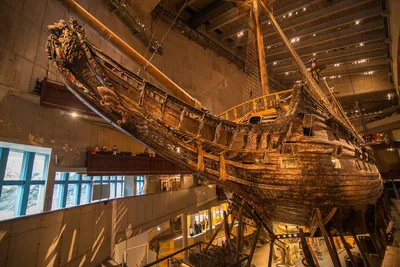 "Vasa", a fully intact 64 gun warship from the 17th century that was salvaged (24229632684).jpg
by Jorge Láscar from Melbourne, Australia, CC BY 2.0. Cropped and resized; no other changes.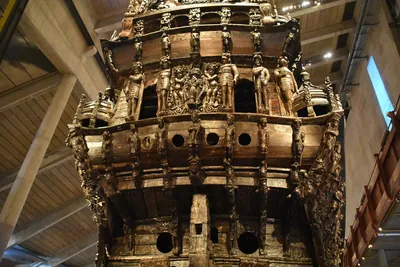 Swedish warship Vasa, sank 1628, Vasamuseet, Stockholm (18) (36225288896).jpg
by Richard Mortel from Riyadh, Saudi Arabia, CC BY 2.0. Cropped and resized; no other changes.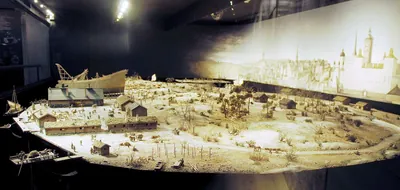 Vasa-Museum Schiffswerft (Modell) Stockholm 1627 (1).JPG
by Hajotthu, CC BY-SA 3.0. Cropped and resized; no other changes. Shared here under the same licence.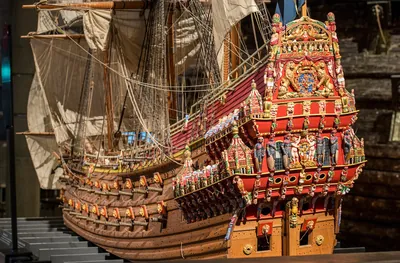 Vasa model showing colour scheme of decorated stern.jpg
by Anneli Karlsson / Vasamuseet, CC BY 4.0. Cropped and resized; no other changes.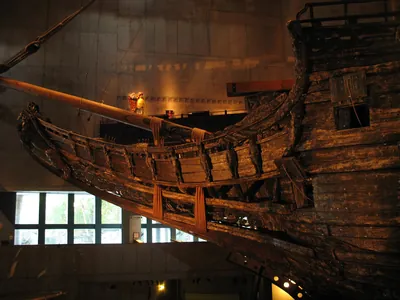 Vasa beakhead1.jpg
by Peter Isotalo, CC BY-SA 3.0. Cropped and resized; no other changes. Shared here under the same licence.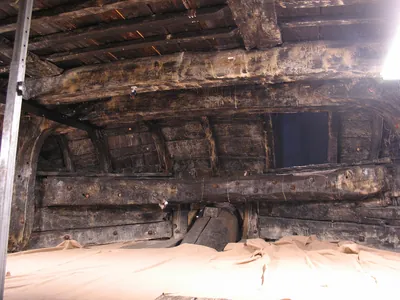 Vasa-upper gun deck-7.jpg
by Peter Isotalo, CC BY-SA 3.0. Cropped and resized; no other changes. Shared here under the same licence.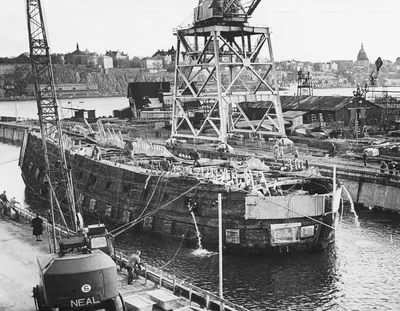 Vasa 14 maj 1961.jpg
by Unknown press photographer, Public domain. Cropped and resized; no other changes.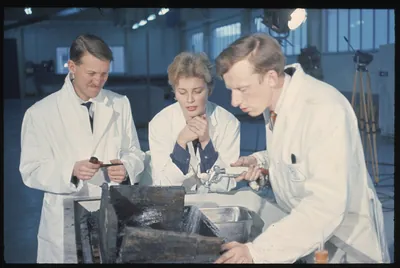 Per Lundström in 1961 3-79.jpg
by Unknown photographer / Vasamuseet, CC0. Cropped and resized; no other changes.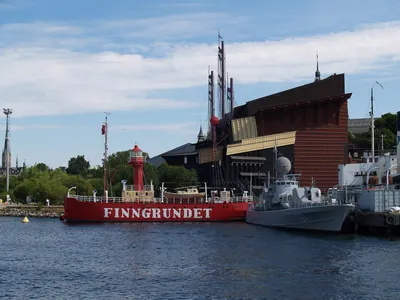 Stockholm vasamuseet from waterside.JPG
by Arnoldius, CC BY-SA 3.0. Cropped and resized; no other changes. Shared here under the same licence.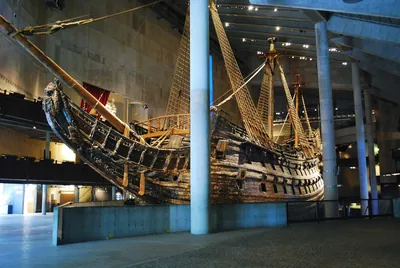 Vasa (5721527927).jpg
by Hugh Llewelyn, CC BY-SA 2.0. Cropped and resized; no other changes. Shared here under the same licence.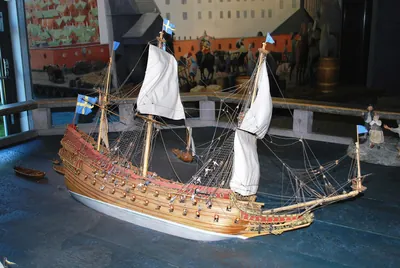 Vasa (5721929224).jpg
by Hugh Llewelyn, CC BY-SA 2.0. Cropped and resized; no other changes. Shared here under the same licence.
Our own drawings
- Simplified side view of Vasa, bow on the left, with three masts, a lion figurehead and a carved stern. Two rows of gunports run along the hull; the lower row, nearest the water, is marked open. Stone ballast lies low in the hold. A dashed line shows a height of more than 50 metres from keel to the main masthead. A note says the length is 69 metres according to the Vasa Museum timeline, or 47 metres according to Vrak.
Our own drawing - Two simplified hull cross-sections side by side. On the left, a hull with plenty of hull below the waterline has its centre of gravity, G, low down near the water. On the right, a hull with little hull below the water and tall sides has G high up. Captions explain that the first rolls back and the second can be pushed over by a gust.
Our own drawing - A schematic of the maiden voyage: the ship casts off below the palace, is warped along the shore to Slussen, sets four of her ten sails, heels in a small gust under the Södermalm cliffs and recovers, then sinks after a stronger gust at Tegelviken, near Beckholmen, after about 1,300 metres.
Our own drawing - Diagram of the 1959 lift: two pontoons, Oden and Frigg, float either side above the wreck, joined to it by steel cables that pass through tunnels under the hull. Numbered steps: flood the pontoons almost full, tighten the cables, pump the water out so the pontoons rise and lift the ship. A note gives a little under a metre per lift, in 18 stages from 32 metres to 17 metres deep near Kastellholmen.
Our own drawing - A timeline from 1625 to 2028 with markers: 1625 ordered; 1628 sinks; 1663 to 1665 most guns raised; 1956 found; 1961 raised; 1962 PEG spraying begins; 1990 museum opens; 2018 bolts replaced; 2028 new support due. A note says 333 years under water, 1628 to 1961.
Our own drawing - Chart comparing three sources. The Vasa Museum says all but 30 survived. Vrak says about 30 died of 150 to 250 aboard. The US Naval Institute article of 1969 guessed 50 drowned of an estimated 134 sailors.
Our own drawing - Two rulers drawn to the same scale. The Swedish foot is 297 millimetres and divided into 12 inches, about 24.8 millimetres each. The Amsterdam foot is 281 millimetres and divided into 11 inches, about 25.5 millimetres each.
Our own drawing - Bar chart of weights: over 1,200 tonnes fitted out in 1628, from the museum timeline; about 900 tonnes around 2000, from the preservation timeline; and today’s estimate of 800 to 1,200 tonnes, from the museum’s facts page. A note says the bolt replacement took about 8 tonnes off.
Our own drawing
The drawings are simplified teaching drawings, not to scale, made from the sourced descriptions on this site. Useless the eraser is the network’s own mascot. Fonts: Bricolage Grotesque, Newsreader and Kalam (SIL Open Font Licence), served from this site.