A ship in a hall
Vasa has had two homes since 1961: a temporary one for 27 years, and the Vasa Museum since 1990.
Vasa, the Swedish warship of 1628. Dates and figures come from the sources linked beside them; where sources disagree, we show each one.
Two museums
From 1961 until 1988 Vasa lived in a temporary home, the Wasavarvet museum. Vasa Museum
The temporary museum opened on 16 February 1962 with a salute from two of Vasa’s cannon; 439,300 people bought tickets that year. Vasa Museum timeline
A Nordic architecture competition in 1981 drew 384 designs. The museum’s page on the building names the winners as Marianne Dahlbäck and Göran Månsson, with their design ‘Ask’. Vasa Museum
The museum’s timeline names the winning firm as Hidemark Månsson Arkitektkontor AB. Vasa Museum timeline
Who designed the museum? Sources differ in the wording
- A Nordic architecture competition in 1981 drew 384 designs. The museum’s page on the building names the winners as Marianne Dahlbäck and Göran Månsson, with their design ‘Ask’. Vasa Museum
- The museum’s timeline names the winning firm as Hidemark Månsson Arkitektkontor AB. Vasa Museum timeline
The two museum pages probably describe the same win, one naming the architects and one their firm. We have not found a source that joins the two up, so we give both.
Building began on 2 November 1987, in a dry dock from 1878. Vasa Museum
In December 1988 Vasa made her last voyage, on a pontoon inside a protective shell, into the water-filled dry dock inside the new museum. Vasa Museum
King Carl XVI Gustaf opened the museum on 15 June 1990. Vasa Museum
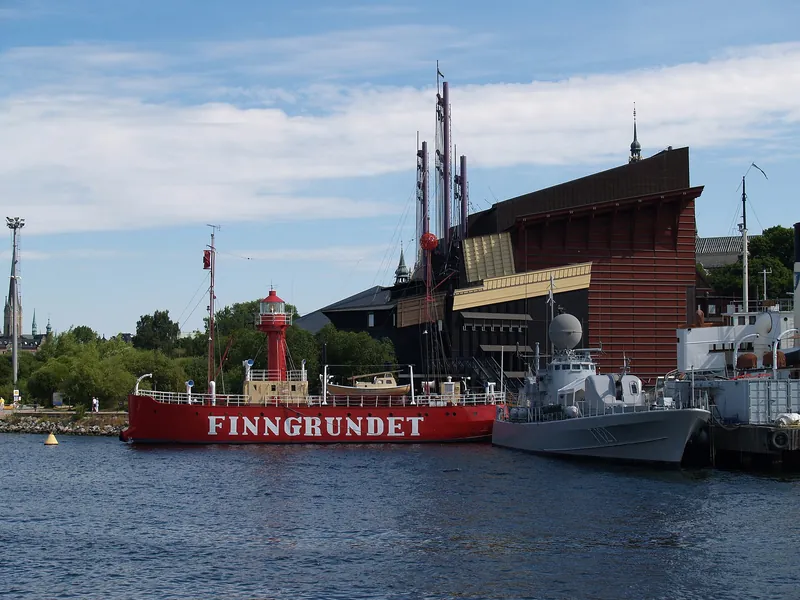
The masts on the roof are a nod to the ship inside; the caption above is our description of the photo, not a sourced fact.
2019 was the busiest year in the museum’s history, with over 1.5 million visitors. Vasa Museum
Vrak says the museum has 1.5 million visitors a year, and more than 40 million people have seen Vasa since she was raised. Vrak museum
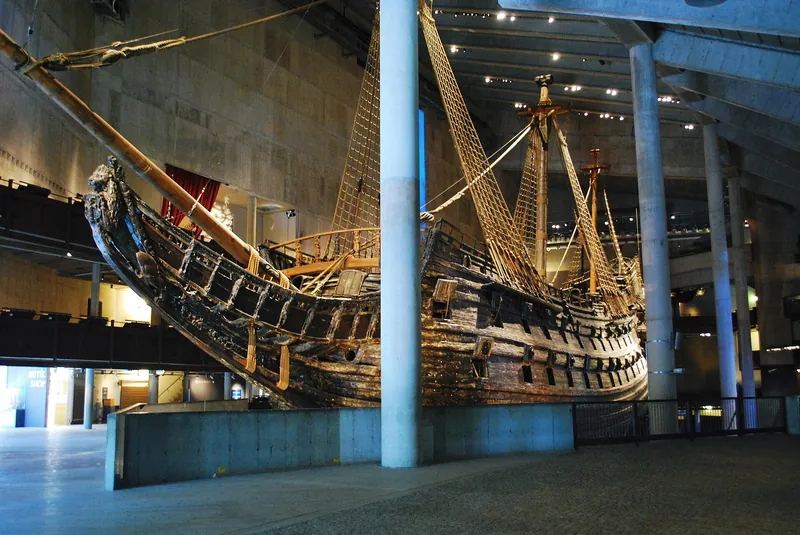
Holding her up
The cradle that has held Vasa since the 1960s is damaging the hull. Its 17 pairs of supports are being replaced with 27 steel cradles plus an internal steel skeleton; the work began in April 2024. Vasa Museum
Vasa leans slightly to port, and the lean is getting worse. The new support is designed so the ship can be straightened once it is all in place. Vasa Museum
Twice-yearly measurements of 400 points since 2000 show the ship settling about 1 mm a year. Vasa Museum
In weakened parts of the hull the wood carries on average 40 per cent less load than fresh wood, and in places 80 per cent less. Vasa Museum
The museum says that without the new support, the ship is at risk of ‘sinking under its own weight’. Vasa Museum
The aim is to finish the new support by 2028, in time for the ship’s 400th anniversary, with the museum open as usual throughout. Vasa Museum
What does Vasa weigh? Sources differ
- Fitted out with ten sails, 64 cannon, 120 tonnes of ballast and hundreds of sculptures, she weighed over 1,200 tonnes, according to the museum’s timeline. Vasa Museum timeline
- The museum’s preservation timeline gives the ship’s weight in 2000 as around 900 tonnes, too heavy for its support. Vasa Museum preservation timeline
- Nobody knows exactly what the ship weighs today: the museum’s estimate is between 800 and 1,200 tonnes, worked out from the density and volume of the timbers. Vasa Museum FAQ
These measure different things at different times: the ship fitted out with guns, sails and ballast in 1628; the hull around 2000; and today’s estimate, which the museum says is uncertain.
The research goes on
Skeletons from at least 17 people were found during the excavation of the 1960s, and more remains were found by divers in 1966. Vasa Museum
New DNA work in 2023 showed that one skeleton thought to be a man was a woman. Vasa Museum
In 2014 researchers test-fired an exact copy of one of Vasa’s guns over 50 times. Its range was over 1,000 metres, but real fighting range was probably under 500, and every shot went through up to 80 cm of oak. Vasa Museum timeline
Visiting
Check before you go. Opening times and prices change. These are from the museum’s own page as we read it on 10 November 2026.
When we checked (page updated 8 October 2026), the museum opened daily 10:00–17:00 from September to May, with late opening to 20:00 on Wednesdays, and 08:30–18:00 from June to August. It is closed on 24 and 25 December. Vasa Museum
Adult tickets were 240 SEK from May to September and 195 SEK the rest of the year; visitors 18 and under go free, and the museum takes cards only. Vasa Museum
A ticket includes a guided tour of about 25 minutes, a 17-minute film about the ship, and free audio guides on your own phone. Vasa Museum
Twelve exhibitions around the ship cover life on board, ships in battle, the sculptures, sailing ships, preservation, the salvage, the sinking and the people who died. Vasa Museum
The exhibition ‘In Life and Death’ presents some of the people who died, using DNA, bone and isotope research. Vasa Museum
Next: myths and tall tales →