Found in 1956, raised in 1961, still being saved
How an amateur archaeologist found Vasa, how divers and two pontoons brought her up, and how the museum has kept the wood from shrinking and the iron from rotting it.
Vasa, the Swedish warship of 1628. Dates and figures come from the sources linked beside them; where sources disagree, we show each one.
Why the wreck survived
The museum says the wood survived well because the ship was new and sank in cold, dark, almost oxygen-free water; only the outer few centimetres were degraded by bacteria. Vasa Museum preservation timeline
The 1969 article says the most important reason the wreck survived was the absence of the wood-eating shipworm, Teredo navalis, in the Baltic’s low-salt water. USNI Proceedings, 1969
The search
In the early 1950s Anders Franzén, a fuel engineer in the navy and an amateur archaeologist, started searching for the navy’s lost ships, with Vasa near the top of his list. Vasa Museum
Dragging the south side of the channel, he found ‘rusty iron stoves and ladies’ bicycles, Christmas trees, dead cats’, and realised he was looking in the wrong place. Vasa Museum
A 1955 survey for a planned bridge showed a lump 50 metres long and six metres high off the Gustav V dry dock on Beckholmen. The navy diver Per Edvin Fälting knew it was not blasting rubble. Vasa Museum
On 25 August 1956 Franzén’s home-made coring device brought up black oak; 20 metres further on, it did it again. Vasa Museum
In early September Fälting went down and felt his way along a wooden wall with two rows of square openings: an old warship with two gundecks. Vasa Museum
The museum says it is ‘a little misleading’ to call the wreck lost: it was on a 19th-century chart, divers visited it in the 1840s and 1860s, and the navy dive school trained on it. Vasa Museum
Franzén’s big contribution was the idea that the ship could be raised and made the centrepiece of a museum, and the skill to persuade people to do it. Vasa Museum
Raising her
The Neptune Company, part of Broströms, Scandinavia’s biggest salvage firm, did the lift and agreed not to charge for it. Vasa Museum
Ideas such as filling the hull with ping-pong balls, or freezing it in a giant ice cube, were quickly dropped; the salvors would only use a proven method. Vasa Museum
From 1957 to 1959 navy divers dug six tunnels under the ship and pulled steel cables through them to two pontoons, Oden and Frigg. Vasa Museum
The pontoons were flooded almost full, the cables tightened, then the water pumped out, so the ship rose with them. Vasa Museum
When a cannon was raised on 5 September 1958, Swedish Radio covered it live. Vasa Museum
The first lift was on 20 August 1959. Each lift gained a little under a metre, and in 18 stages the ship was moved to 17 metres deep near Kastellholmen. Vasa Museum
The 1969 article gives the cable as some 4,500 feet of 6-inch steel wire, and says the first move took 28 days. USNI Proceedings, 1969
For more than 18 months divers plugged bolt holes, covered the gunports and rebuilt the bow and stern to make the hull watertight. Vasa Museum
At 09.03 on 24 April 1961 the first eroded frames broke the surface, then four carved warriors’ heads. Swedish Television broadcast it live to all of Europe. Vasa Museum
Into dry dock
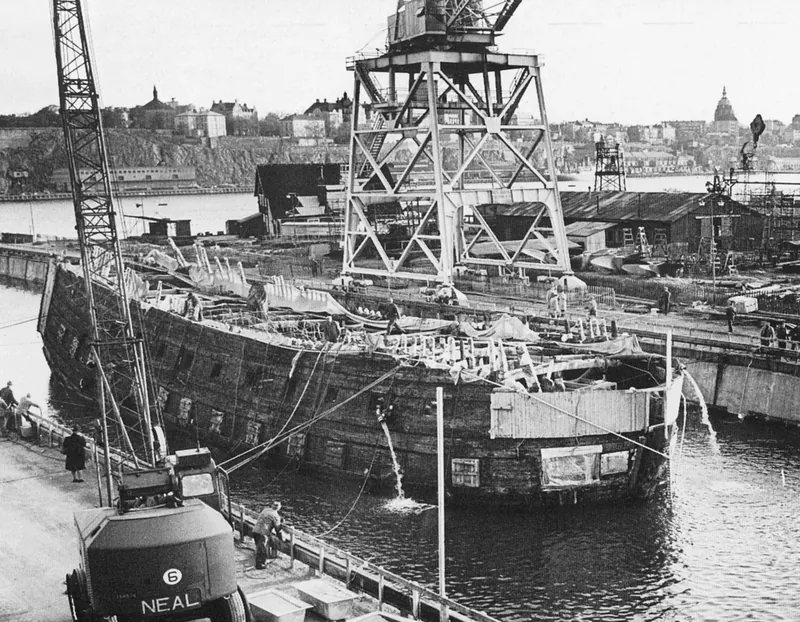
On 4 May 1961 Vasa was towed to the Gustav V dry dock on Beckholmen and floated on her own keel onto a concrete pontoon. Vasa Museum
The excavation
Archaeologists led by Per Lundström worked aboard for five months in a constant muddy drizzle, because the ship was sprayed with water day and night. Vasa Museum
Finds went into water tanks to wait for conservation. There were not enough, so the project bought up old bathtubs from Stockholm’s scrap merchants. Vasa Museum
In those five months the team recovered more than 30,000 objects. Vasa Museum
Over 4,000 coins were found, all small change, in chests and in the pockets of clothes worn by eleven skeletons on the decks. Vasa Museum
Six of Vasa’s sails were found folded in a locker, still tied up as they had come from the sailmaker in 1627. Vasa Museum
From 1963 to 1967 divers searched ‘the Pit’ where she had lain, recovering many sculptures, the beakhead, upper sterncastle, anchors and the longboat, nearly 12 metres long with a smaller boat inside. Vasa Museum
Over 40,000 objects were found in and around the ship. Vasa Museum
Conservation
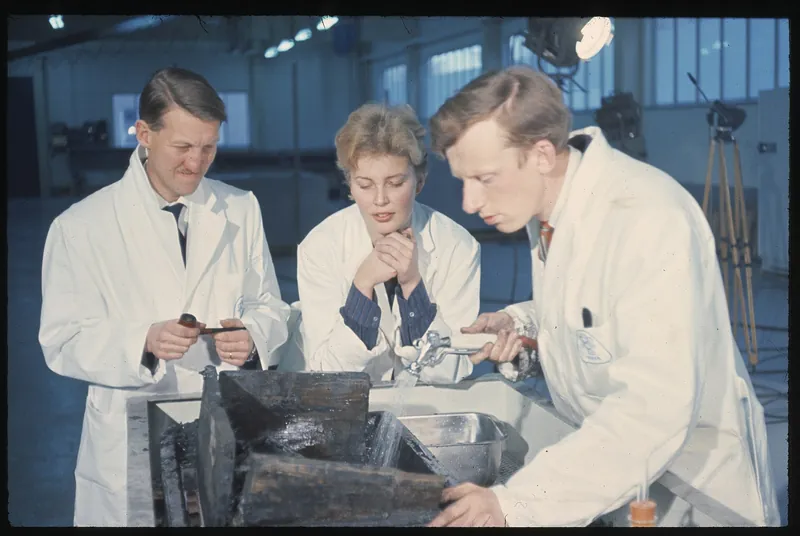
To stop the waterlogged wood shrinking and cracking as it dried, the hull was sprayed with polyethylene glycol (PEG), a water-soluble wax, from April 1962 to January 1979. Vasa Museum
At first spraying was done by hand: five men took five hours to cover the ship. An automatic system with 500 nozzles followed in 1965. Vasa Museum
After 17 years of spraying came another nine years of slow air-drying. Vasa Museum
PEG is also found in cosmetics such as lipsticks and face creams. Vasa Museum
The sails were so fragile they could not carry their own weight. Conservators backed them with fibreglass fabric, a job that took over a decade; the museum holds the remains of 650 square metres of sail. Vasa Museum
New problems
Almost all the 5,000 iron fastenings corroded on the seabed, and sulphur from the polluted harbour water got into the wood. Vasa Museum preservation timeline
In the rainy summer of 2000, crowds of wet visitors sent the humidity swinging, and yellow and white acidic spots appeared on the ship. Vasa Museum timeline
A new climate system in 2004 keeps the hall at 53 ± 2 per cent humidity and 18.5 ± 1.5 °C. Vasa Museum preservation timeline
Replacing the rusty 1960s bolts took seven years and was finished in 2018: more than 5,000 bolts, saving about 8 tonnes. The museum expects the new ones to last at least 150 years. Vasa Museum preservation timeline
How many bolts? Sources differ
- Replacing the rusty 1960s bolts took seven years and was finished in 2018: more than 5,000 bolts, saving about 8 tonnes. The museum expects the new ones to last at least 150 years. Vasa Museum preservation timeline
- The museum’s main timeline puts it at 4,000 bolts and says the ship is ‘now eight tons lighter’. Vasa Museum timeline
Both figures come from the Vasa Museum’s own pages. The preservation timeline, which also says the ship had about 5,000 iron fastenings in all, is the more detailed account.
The next stage, a whole new support for the hull, is on the museum page.
Next: the museum today →